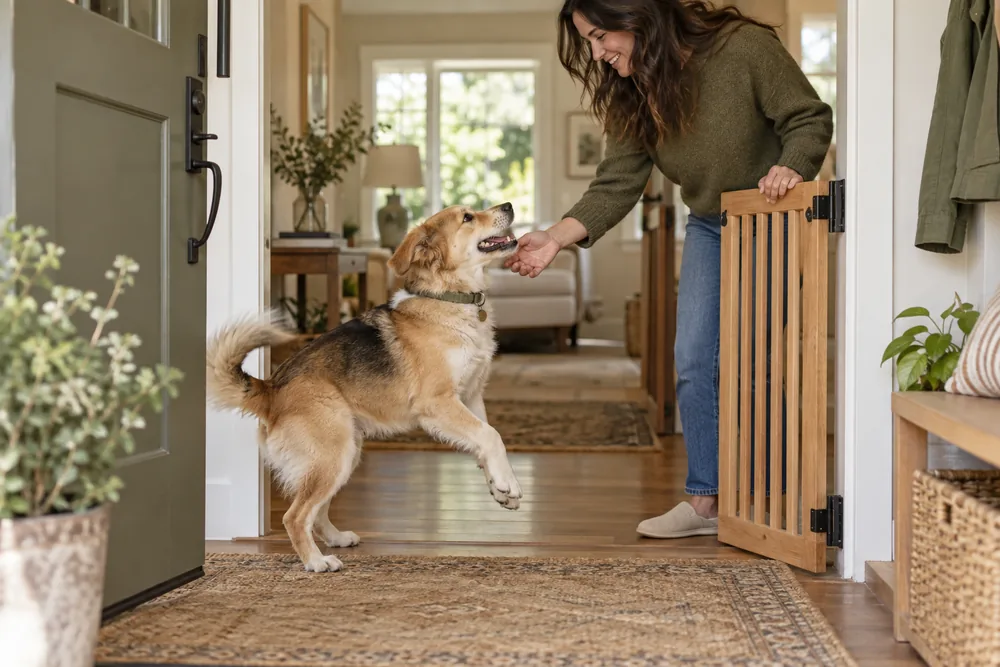
Quick answer
arrange greetings so your dog can keep four paws down, reward that moment and make the greeting less exciting if they cannot. Start with a willing adult helper, not an unsuspecting visitor.
Why greetings go wrong
A visitor bends down, speaks in an excited voice and touches the dog just as the front paws lift. To the dog, jumping may be part of a successful greeting. If another person then scolds the same behavior, the rules become hard to predict.
Dogs Trust explains that attention from family and friends can help maintain jumping. That does not mean every jumping dog is asking for affection. Look at the whole interaction. A dog backing away, stiffening or trying to escape needs space, not a more determined greeting.
Set up one manageable rehearsal
Choose an adult your dog is comfortable around. Use a gate or enough distance to prevent a full-speed launch. Let the helper know exactly what to do before they approach. Do not use a child, a frail person or someone frightened of dogs as your training assistant.
Put rewards within reach. Choose a quiet moment when your dog has had a toilet opportunity and is not already highly aroused.
The four-paws greeting
- The helper stands sideways at a comfortable distance and stays quiet.
- Reward your dog for keeping paws on the floor before the person comes closer.
- Let the helper take one small step toward you.
- If paws remain down and your dog looks comfortable, reward again. A brief greeting can follow.
- If your dog jumps, the helper calmly pauses and steps back. Reset at an easier distance.
A sit can be an alternative if your dog knows it comfortably, but it is not compulsory. Four paws on the ground is a simpler first target than a perfectly held sit while a visitor looms overhead.
Make real visits easier
Rehearsals and real life need separate plans. For an exciting delivery, use a safe room or barrier before opening the door. Give ordinary visitors clear instructions and avoid letting them practise an enthusiastic greeting “just this once.”
Reward before the jump whenever you can. If every repetition becomes jump, land, treat, make the approach easier so you can catch the desired behavior earlier.
Troubleshooting
If your dog cannot manage one step, begin farther away. If the helper speaks, waves or leans over the dog, simplify their role. If your dog is mouthing clothes or cannot recover, stop the greeting and allow a calm break.
Never knee the chest, yank the collar or pin the dog down. Manage the situation and teach an alternative. If jumping occurs with growling, snapping or fear, use distance and professional guidance.
Common questions
Must every greeting be a training session?
No. Sometimes a barrier and a quiet activity are the sensible choice. Rehearse when people can cooperate.
Can guests reward the dog?
Yes, if safe and comfortable. Delivering the reward low can help keep the greeting at floor level.