Quick answer
begin with connection and practical routines. A name response, a few steps toward you and comfortable handling at the puppy’s pace can be more useful than a long list of formal commands.
Choose skills you will use today
Your puppy does not need to graduate from a miniature obedience school in the first week. Pick one clear response that will make daily life easier. Keep expectations small and allow the puppy to leave a lesson.
Prepare tiny, suitable rewards and a quiet space. Teach away from stairs, open doors and slippery surfaces. A hungry, tired or overwhelmed puppy may need basic care before a lesson.
Skill 1: turn toward your name
When your puppy is close and not absorbed in something else, say their name once. Reward a comfortable turn toward you. Let them return to exploring. After a few successful repetitions, finish.
If there is no response, do not keep chanting the name. Try again later in an easier moment. Avoid using the name mainly before taking away something enjoyable.
Skill 2: come a few steps
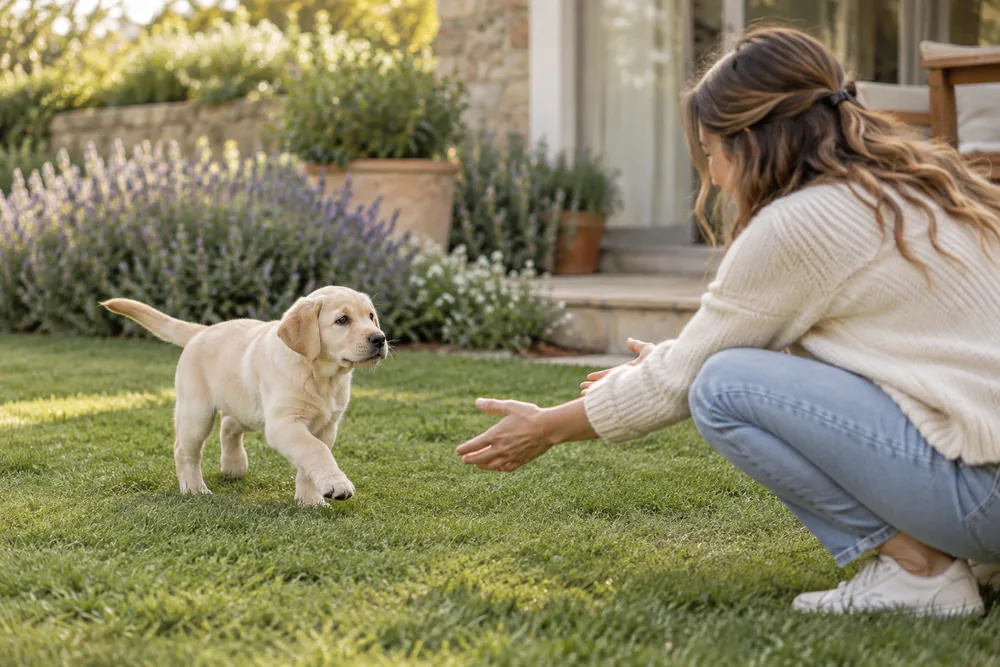
In a secure room, crouch or stand in a welcoming position a short distance away. Use a cheerful cue and reward the puppy when they approach. Keep the distance so small that success is easy.
Never practise near an unsecured road or open exit. Outdoor freedom should not depend on an untested puppy recall. Use appropriate physical safety measures as skills develop.
Skill 3: follow an empty-hand target
A comfortable nose touch to a presented palm can help guide movement. Present the hand nearby, mark a voluntary investigation and reward from the other hand. Do not push toward the face. Skip this if the puppy is worried by hands.
The same skill can later help with simple positioning, but do not use it to lure the puppy into a situation they fear.
Skill 4: cooperate with tiny routines
Let the puppy investigate a harness or brush without immediately putting it on or using it. Pair a small, comfortable step with something pleasant, then stop. Handling should progress according to the puppy’s response, not how much you hoped to finish.
If they freeze, retreat or struggle, reduce the demand. For pain or significant handling fear, seek guidance rather than repeatedly rehearsing the distress.
Keep a tiny success record
Write “turned toward name in quiet kitchen” rather than “learned name.” The first statement tells you exactly what is reliable. It also helps you choose the next slightly different context.
Pick one variable to change. A longer distance in the same room may be enough. You do not need to add visitors and noise on the same day.
Common questions
Do I need to teach sit first?
It can be useful, but it is not a requirement before every other skill. Choose a comfortable movement and a practical goal.
How do I stop relying on visible food?
Deliver rewards after the response once a cue is understood. Do not keep displaying the lure as a permanent condition for participation.