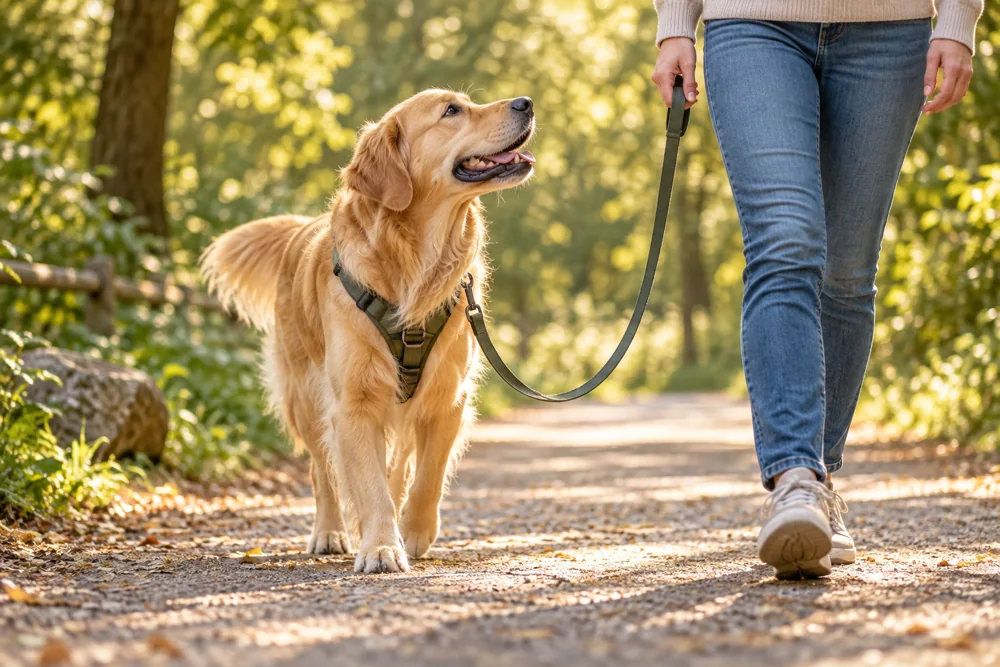
Quick answer
reward your dog for walking where the leash stays slack. Begin in an easy space and gradually practise in more interesting places. A loose leash allows ordinary exploration; it does not require a competition heel.
Separate the lesson from the journey
It is hard to learn while hurrying to a destination. Choose a safe, quiet stretch for a brief lesson and allow the rest of the outing to meet your dog’s needs. A comfortable, well-fitted harness and ordinary leash can help you manage safely. Check fit and escape risk before leaving home.
If your dog lunges at traffic, people or other dogs, this is not simply a walking-position lesson. Create distance and seek qualified support rather than practising beside the trigger.
Teach the first few steps
- Start indoors or in a secure, low-distraction area. Stand with the leash slack.
- Reward your dog beside you at a comfortable height.
- Take one or two steps. If the leash remains loose, mark and reward near your leg.
- Pause, reset and repeat. Change direction gently before you run out of room.
- Gradually add steps only when the shorter version is easy.
Keep your reward delivery consistent. If you reach far ahead every time, you may encourage the dog to forge in front for the food. Do not hold a treat at your dog’s nose for the entire walk.
What to do when the leash tightens
In a safe situation, pause without jerking. Invite an easy reset when your dog can reconnect, then reward the next loose steps. Avoid turning this into a tug-of-war or holding position while the dog panics. Move to safety if the location is busy or frightening.
Dogs Trust recommends reinforcing proximity and progressing gradually. Your own small-step plan might be two steps by the front door today and five relaxed steps in a quiet outdoor spot later. Those numbers are examples, not a schedule every dog must meet.
Use the environment as part of the reward
A chance to sniff can be valuable. When the leash is slack, use a consistent release phrase and walk with your dog toward a safe sniffing spot. Keep room in the walk for exploration rather than asking for constant attention.
Notice when pulling starts. Is it always near the park gate? Begin practice farther away next time. If your dog cannot respond there, reduce the challenge rather than repeating the same frustrating route.
Common mistakes and fixes
Starting on the busiest street: practise the movement pattern somewhere easier first.
Expecting twenty perfect minutes: train short sections and build gradually.
Stopping without teaching anything else: reward the loose position so your dog has a useful alternative.
Common questions
Must my dog walk on the left?
Choose a safe side that works for you. Consistency can make early learning easier; the side itself is not a moral rule.
Will a harness teach the skill?
Equipment can help with comfort and management. Your reward timing, environment and practice still matter.